
heattransferequipments.com > products > heat exchangers > cooling towers
HEAT EXCHANGERS & COOLING TOWER MANUFACTURER
Heat Transfer Equipment Pvt Ltd.,
HEAT EXCHANGERS
COOLING TOWERS
Surface Condenser
A surface condenser is a heat-transfer equipment used to condense exhaust steam by transferring its heat to a separate cooling-water circuit. The steam and cooling water remain physically separated throughout the process, allowing the resulting condensate to be collected and reused within the system.
This arrangement is particularly useful in power generation and industrial steam systems where recovering condensate and maintaining efficient plant operation are important. The equipment can be designed according to steam flow, vacuum conditions, cooling-water temperature, heat-transfer duty, and required condensate recovery.
What Is a Surface Condenser?
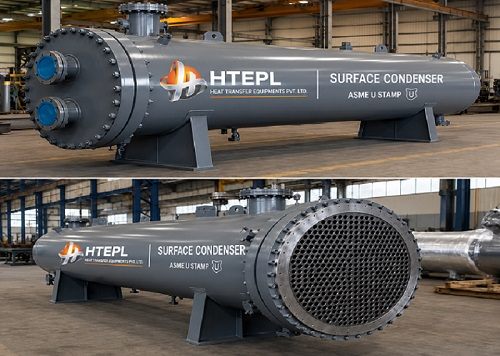
A surface condenser is a shell-and-tube type heat exchanger in which steam condenses on one side of the heat-transfer tubes while cooling water flows through the tubes on the other side.
Unlike a direct-contact or jet condenser, the two fluids do not come into direct contact. This separation makes it possible to recover relatively clean condensate and return it to the boiler or steam-generation system.
Surface condensers are commonly selected for applications where condensate recovery, controlled cooling-water circulation, and reliable steam condensation are required.
Working Principle of a Surface Condenser
Exhaust steam enters the condenser shell and comes into contact with the outer surfaces of the heat-transfer tubes. Cooling water flows through the tubes and absorbs heat from the steam.
As the steam loses its latent heat, it changes from vapor into liquid condensate. The condensate collects in the appropriate section of the condenser and can then be removed using a condensate extraction system.
The cooling water carries the absorbed heat away from the condenser and is returned to the cooling-water system for further circulation or discharge, depending on the plant arrangement.
The required condenser performance depends on steam flow, cooling-water flow, inlet temperatures, vacuum level, heat-transfer surface area, and allowable pressure drop.
Surface Condenser Design & Construction
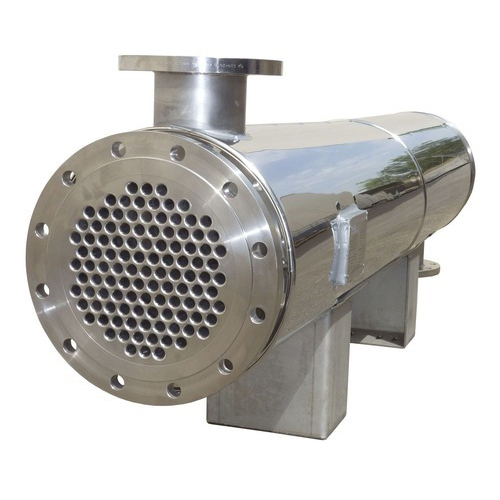
Surface condensers are generally designed around a shell-and-tube configuration, with the tube bundle providing the primary heat-transfer surface.
The design can be customized according to the required steam-condensing duty, cooling-water conditions, operating pressure, temperature, available space, and plant layout.
Important design parameters include:
- Steam flow rate
- Cooling-water flow rate
- Steam inlet conditions
- Cooling-water inlet temperature
- Condensing pressure or vacuum
- Required condensate temperature
- Heat-transfer area
- Tube diameter and length
- Tube arrangement and pitch
- Allowable pressure drop
- Material compatibility
- Fouling and corrosion conditions
The condenser can be engineered for the specific requirements of power plants and industrial steam systems.
Major Components of a Surface Condenser
A surface condenser consists of several components that work together to achieve effective steam condensation and condensate recovery.
Tube Bundle
The tube bundle provides the heat-transfer surface between the steam and cooling water. Tube dimensions, arrangement, and material are selected according to the operating conditions.
Shell
The shell contains the steam side of the condenser and provides the required pressure boundary around the tube bundle.
Water Boxes
Water boxes distribute cooling water into and out of the tube bundle. Their configuration depends on the required flow arrangement and number of tube passes.
Tube Sheets
Tube sheets support and secure the heat-transfer tubes while maintaining separation between the steam and cooling-water circuits.
Condensate Collection Section
Condensed steam is collected in the designated condensate area before being transferred to the condensate extraction system.
Nozzles and Connections
Steam, cooling water, condensate, venting, draining, and other process connections are provided according to the equipment design.
Types of Surface Condensers
Surface condensers can be configured in different ways depending on the plant requirements and the arrangement of the cooling-water and condensate systems.
Single-Pass Surface Condenser
Cooling water travels through the tube bundle in a single pass before leaving the condenser. This arrangement can be suitable where the available cooling-water flow and pressure conditions support single-pass operation.
Multi-Pass Surface Condenser
In a multi-pass arrangement, cooling water changes direction within the condenser and passes through different sections of the tube bundle. This can provide greater flexibility in heat-transfer design and water-flow management.
Horizontal Surface Condenser
Horizontal configurations are commonly used in power-generation and industrial installations where the condenser is arranged beneath or near the steam exhaust system.
Custom Surface Condenser Arrangements
The equipment can also be configured according to plant-specific requirements, including tube layout, water-box arrangement, condensate extraction position, and installation limitations.
Tube Materials and Construction Options
Tube material selection is an important part of surface condenser design because the tubes are exposed to cooling water and thermal cycling during operation.
Depending on the water quality and process conditions, suitable tube materials may include stainless steel, copper alloys, copper-nickel alloys, titanium, and other compatible materials.
Material selection can consider:
- Cooling-water chemistry
- Chloride concentration
- Corrosion resistance
- Fouling tendency
- Operating temperature
- Mechanical strength
- Expected service life
- Maintenance requirements
The tube construction and wall thickness are selected according to the applicable mechanical and process requirements.
Condensation and Heat Transfer Process
The main thermal function of a surface condenser is to remove latent heat from exhaust steam and convert it into condensate.
Cooling water absorbs the heat transferred through the tube walls while the steam condenses on the opposite side. Maintaining a suitable temperature difference between the steam and cooling water is important for achieving the required heat-transfer rate.
Condenser performance can be influenced by:
- Steam pressure
- Steam flow rate
- Cooling-water temperature
- Cooling-water velocity
- Heat-transfer surface area
- Tube cleanliness
- Air or non-condensable gas accumulation
- Fouling and scaling
Proper design and operating conditions help maintain the desired condensing pressure and overall plant performance.
Surface Condenser Applications
Surface condensers are widely used where steam must be condensed while keeping the condensate separate from the cooling medium.
Typical applications include:
- Steam turbine exhaust systems
- Thermal power plants
- Industrial power-generation systems
- Process steam systems
- Cogeneration plants
- Boiler and steam-cycle systems
- Industrial condensate recovery systems
- Large steam-driven equipment
They are particularly useful in systems where recovered condensate is valuable for reuse.
Common Uses of Surface Condensers
Surface condensers perform several important duties within steam and power systems.
Exhaust Steam Condensation
They condense steam leaving a turbine or other steam-consuming equipment and convert it back into liquid form.
Condensate Recovery
The resulting condensate can be collected and returned to the boiler feedwater system, helping reduce the requirement for fresh water.
Vacuum Maintenance
In suitable steam-cycle applications, the condenser helps maintain the required low-pressure condition at the turbine exhaust.
Heat Removal
The cooling-water circuit carries away the latent heat released during steam condensation.
Boiler Feedwater Reuse
Recovered condensate can be treated and returned to the steam-generation cycle as boiler feedwater, subject to the plant’s water-treatment requirements.
Advantages of Surface Condenser Systems
Surface condensers offer several benefits for steam-cycle and industrial applications:
- Steam and cooling water remain separated
- Condensate can be recovered for reuse
- Suitable for closed steam-water cycles
- Cooling-water quality does not directly contaminate the condensate
- Can support efficient steam-cycle operation
- Suitable for different cooling-water arrangements
- Flexible tube material selection
- Can be engineered for large steam loads
- Supports condensate recovery and water conservation
- Suitable for power-generation applications
Although the initial equipment and installation cost can be higher than some direct-contact arrangements, the ability to recover condensate and operate with a separate cooling-water circuit can provide important long-term benefits.
Key Design Considerations
A surface condenser should be designed according to the complete operating conditions rather than heat-transfer duty alone.
Important considerations include:
- Steam flow and composition
- Condensing pressure
- Cooling-water flow rate
- Cooling-water temperature
- Tube-side velocity
- Heat-transfer coefficient
- Required heat-transfer area
- Fouling allowance
- Corrosion allowance
- Non-condensable gases
- Tube material
- Allowable pressure drop
- Condensate extraction arrangement
- Installation space
Cooling-water quality should also be evaluated carefully. Factors such as dissolved salts, chlorides, suspended solids, biological growth, and scaling potential can influence tube selection and maintenance requirements.
Surface Condenser Cleaning & Maintenance
Regular inspection and cleaning are important for maintaining condenser performance.
Typical maintenance activities include:
- Inspecting tube surfaces
- Removing scale and deposits
- Checking for tube leakage
- Monitoring cooling-water pressure drop
- Checking cooling-water flow
- Inspecting water boxes
- Checking tube-sheet areas
- Monitoring condenser vacuum
- Inspecting condensate quality
- Checking for corrosion or erosion
Tube cleaning methods should be selected according to the tube material, deposit type, and equipment design. Regular performance monitoring can help identify fouling or leakage before it significantly affects plant operation.
Industries Using Surface Condensers
Surface condensers are suitable for a range of industries that operate steam, turbine, or thermal-energy systems, including:
- Power generation
- Thermal power plants
- Cogeneration facilities
- Chemical processing
- Petrochemical industries
- Oil and gas
- Refineries
- Process manufacturing
- Heavy industries
- Industrial steam plants
The condenser configuration can be developed according to the specific process requirements, cooling-water conditions, operating pressure, and available installation space.
Frequently Asked Questions (FAQ)
What is the main purpose of a surface condenser?
A surface condenser removes heat from exhaust steam and converts it into condensate while keeping the steam and cooling water physically separated.
Can the condensate from a surface condenser be reused?
Yes. The condensate can generally be collected and returned to the boiler feedwater system after meeting the required water-quality conditions.
Does cooling water mix with steam in a surface condenser?
No. The cooling water flows through the heat-transfer tubes while the steam condenses outside the tubes, keeping the two fluids separated.
What cooling water can be used in a surface condenser?
The suitability of cooling water depends on its chemistry, temperature, flow rate, fouling potential, and corrosiveness. Tube material should be selected accordingly.
What materials are used for surface condenser tubes?
Depending on the service conditions, tube materials may include stainless steel, copper alloys, copper-nickel alloys, titanium, and other suitable materials.
How can surface condenser performance be maintained?
Maintaining proper cooling-water flow, monitoring vacuum and pressure drop, controlling fouling, inspecting tubes, and carrying out periodic cleaning can help maintain performance.
Request a Quote for a Surface Condenser
Looking for a surface condenser designed for your steam-cycle or industrial application? Share your steam flow rate, operating pressure, cooling-water conditions, inlet and outlet temperatures, required heat-transfer duty, and preferred materials with our engineering team.
Heat Transfer Equipments can develop a surface condenser configuration based on your process requirements, installation conditions, and operating parameters.
Contact us to discuss your requirement and receive a customised technical proposal and quotation.