
heattransferequipments.com > products > heat exchangers > cooling towers
HEAT EXCHANGERS & COOLING TOWER MANUFACTURER
Heat Transfer Equipments Pvt Ltd.,
HEAT EXCHANGERS
COOLING TOWERS
Air Blast Oil Cooler
Heat Transfer Equipments Pvt. Ltd. is an Air Blast Oil Cooler manufacturer in India, providing customized oil cooling solutions for industrial machinery, hydraulic systems, gearboxes, lubrication systems, and process equipment.
Air Blast Oil Coolers use ambient air to remove heat from circulating oil. The heated oil passes through a finned heat transfer surface while a fan moves air across the cooler, transferring heat from the oil to the surrounding atmosphere.
The cooler configuration, heat rejection capacity, oil flow rate, fin arrangement, fan capacity, materials, and dimensions can be selected according to the application requirements.
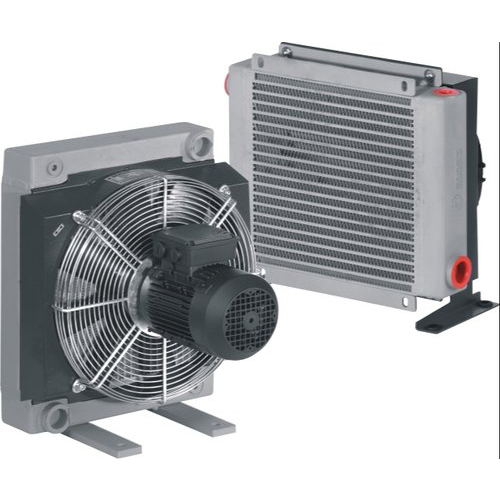
What Is an Air Blast Oil Cooler?
An Air Blast Oil Cooler is an air-cooled heat exchanger designed to reduce the temperature of lubricating, hydraulic, or process oil.
Unlike water-cooled oil coolers, an air blast configuration uses atmospheric air as the cooling medium. Hot oil flows through tubes or suitable heat transfer passages, while forced air passes across the external finned surfaces.
The heat from the oil is transferred to the air, reducing the oil temperature before it returns to the equipment or process.
How Does an Air Blast Oil Cooler Work?
The working principle is based on forced-air heat transfer.
Hot oil enters the cooler through the oil inlet and flows through the internal tubes or heat transfer passages. A fan draws or pushes ambient air across the external finned surfaces.
Heat from the oil passes through the tube wall and fins into the moving air. The cooled oil then leaves through the outlet and returns to the lubrication, hydraulic, or process system.
Cooling performance depends on oil flow rate, oil inlet temperature, required outlet temperature, ambient air temperature, airflow, heat transfer area, fin configuration, and allowable pressure drop.
Air Blast Oil Cooler Construction and Components
An Air Blast Oil Cooler is constructed with components selected according to the required heat rejection duty and operating conditions.
Typical components can include:
- Heat transfer tubes
- Extended or finned surfaces
- Oil inlet and outlet connections
- Fan assembly
- Electric motor
- Fan guard
- Supporting frame
- Mounting arrangements
- Protective casing or structure where applicable
Tube material, fin material, tube dimensions, fin spacing, fan capacity, motor rating, and overall cooler dimensions can be customized according to the application.
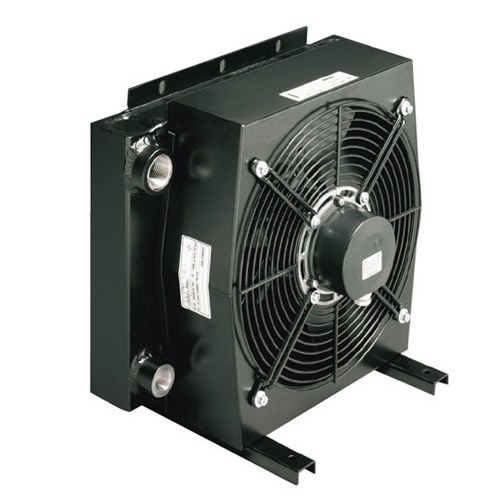
Types of Air Blast Oil Coolers
Different configurations can be selected depending on oil characteristics, cooling duty, installation space, and operating conditions.
Forced Air Oil Coolers
Forced-air oil coolers use a fan to move ambient air across the heat transfer surface. They can be used where controlled airflow is required for oil cooling.
Fan-Assisted Oil Coolers
Fan-assisted configurations combine a heat transfer core with a dedicated fan and motor assembly to provide the required airflow for heat rejection.
Finned Tube Air Blast Oil Coolers
Finned tube configurations increase the external heat transfer area and can provide efficient air-side heat transfer for suitable industrial oil-cooling applications.
Air Blast Oil Cooler Design Parameters
Proper thermal and mechanical design is important for achieving the required oil cooling performance.
Important design parameters include:
- Oil flow rate
- Oil inlet temperature
- Required oil outlet temperature
- Ambient air temperature
- Heat rejection duty
- Airflow requirement
- Heat transfer area
- Tube and fin materials
- Fin spacing
- Allowable oil-side pressure drop
- Fan capacity
- Motor capacity
- Oil viscosity and properties
- Fouling conditions
- Available installation space
- Mounting requirements
The final configuration should be determined according to actual operating conditions and project requirements.
Advantages of Air Blast Oil Coolers
Air Blast Oil Coolers can provide several benefits for suitable industrial applications:
- Uses ambient air as the cooling medium
- No cooling-water circuit is required
- Suitable for continuous oil cooling
- Compact configurations can be developed for selected applications
- Suitable for hydraulic and lubrication systems
- Customizable heat rejection capacity
- Suitable for industrial machinery and process equipment
- Reduced dependence on cooling-water availability
- Fan-assisted airflow provides controlled cooling performance
Actual performance depends on cooler design, oil properties, ambient conditions, airflow, heat transfer area, and operating conditions.
Air Blast Oil Cooler Applications
Air Blast Oil Coolers can be used where oil temperature needs to be controlled for reliable equipment operation.
Steel Plants
They can be used for cooling hydraulic and lubrication oil associated with steel-processing equipment, rolling mills, and other machinery.
Sugar Plants
Air blast oil coolers can support oil cooling requirements for gearboxes, hydraulic systems, and industrial machinery used in sugar-processing plants.
Paper Mills
They can be used for cooling lubrication and hydraulic oil in paper-making machinery and associated drive systems.
Machine Tools
Air Blast Oil Coolers can help control oil temperature in machine tools and other precision industrial equipment.
Hydraulic Systems
They can be used to remove heat from hydraulic oil and help maintain suitable operating temperatures in hydraulic equipment.
Gearbox and Lubrication Systems
The cooler can be used for controlling lubricant temperature in industrial gearboxes, drives, bearings, and lubrication circuits.
Industrial Machinery
Customized Air Blast Oil Coolers can be integrated with various industrial machines where oil temperature control is required.
Air Blast Oil Cooler Maintenance and Common Issues
Regular maintenance helps maintain heat transfer performance and reliable fan operation.
Air Blast Oil Cooler Inspection
Inspection can include checking the heat transfer core, fins, tubes, oil connections, fan, motor, mounting structure, and protective components.
Cleaning Fins and Tubes
Dust, dirt, and debris can accumulate on the external fin surfaces and restrict airflow. Periodic cleaning helps maintain effective air-side heat transfer.
Fan and Motor Inspection
The fan, motor, bearings, electrical connections, and mounting arrangements should be checked periodically for vibration, abnormal noise, and proper operation.
Customized Air Blast Oil Cooler Solutions
Heat Transfer Equipments Pvt. Ltd. provides customized Air Blast Oil Cooler solutions based on specific oil cooling requirements.
Our engineering approach considers oil flow rate, inlet and outlet temperatures, oil properties, ambient conditions, heat rejection duty, pressure drop, heat transfer area, fan and motor requirements, material selection, installation space, and mounting arrangements.
The cooler can be developed according to the required thermal performance, mechanical requirements, equipment interface, and project specifications.
Air Blast Oil Cooler Manufacturing and Quality
Heat Transfer Equipments Pvt. Ltd. focuses on manufacturing oil cooling equipment according to application requirements, operating conditions, material specifications, and project requirements.
Application-Based Engineering
The cooler configuration is selected according to heat rejection duty, oil flow rate, temperature conditions, ambient air temperature, and installation requirements.
Material Selection
Tube, fin, frame, and other construction materials are selected according to oil compatibility, temperature, corrosion conditions, and service requirements.
Customized Construction
Heat transfer core dimensions, fin arrangement, fan capacity, motor selection, connections, mounting arrangement, and overall dimensions can be customized according to the application.
Inspection and Testing
Manufacturing and inspection activities can include dimensional checks, component inspection, assembly verification, and project-specific testing requirements.
Project-Specific Technical Support
Technical support focuses on understanding the oil cooling requirements and developing a suitable cooler configuration for the customer’s equipment or process.
Frequently Asked Questions
What Is an Air Blast Oil Cooler Used For?
It is used to cool lubricating, hydraulic, and process oil in industrial machinery, gearboxes, hydraulic systems, and other equipment.
How Does an Air Blast Oil Cooler Cool Oil?
Hot oil passes through the heat transfer core while a fan moves ambient air across the fins. Heat is transferred from the oil to the air, reducing the oil temperature.
Can an Air Blast Oil Cooler Be Customized?
Yes. Heat transfer area, oil flow capacity, fin configuration, fan capacity, materials, dimensions, connections, and mounting arrangements can be customized.
What Information Is Needed for Selection?
Oil flow rate, inlet and outlet temperatures, oil properties, ambient temperature, heat rejection duty, pressure drop, and installation space are typically required.
Where Are Air Blast Oil Coolers Used?
They are used in steel plants, sugar plants, paper mills, machine tools, hydraulic systems, gearboxes, lubrication systems, and other industrial machinery.
Request a Quote for an Air Blast Oil Cooler
Looking for a reliable Air Blast Oil Cooler manufacturer in India?
Share your oil flow rate, oil inlet and outlet temperatures, oil type, ambient temperature, required heat rejection capacity, allowable pressure drop, installation space, and equipment details with our engineering team.
Heat Transfer Equipments Pvt. Ltd. can provide a customized Air Blast Oil Cooler solution based on your process and equipment requirements.