Why Air Receiver Tanks Save Energy in Compressed Air Systems
Imagine running a marathon where you aren’t allowed to take a deep, steady breath—instead, you have to gasp for tiny sips of air the exact millisecond your body demands it. Exhausting, right?
That is precisely how your factory’s pneumatic tools, automated valves, and production lines can behave when your compressed air system lacks a properly sized buffer. Compressors work hard to generate compressed air, but without adequate storage capacity, the system can experience pressure fluctuations, inefficient compressor operation, and unnecessary energy consumption.
Enter the Air Receiver Tank: the quiet, heavy-duty guardian of compressed-air system stability and plant efficiency.
The Hidden Cost of Running “Direct-to-Line” Air
Too many plant managers view a compressed-air storage tank as little more than an oversized metal cylinder. This misconception can result in avoidable operational problems:
The Constant Cycling Trap
Without adequate storage capacity, a compressor may need to respond more frequently to changing air demand. Frequent loading and unloading can increase mechanical and electrical stress and may contribute to unnecessary energy consumption.
Pressure Starvation
Sudden demand surges on the factory floor can cause pressure fluctuations in the compressed-air network. This may affect pneumatic actuators, control valves, assembly equipment, and other air-operated machinery.
Moisture-Related Problems
Hot compressed air can contain significant amounts of water vapor. As the air cools, moisture can condense and travel through the compressed-air system if appropriate moisture management is not provided. This can contribute to corrosion and affect downstream pneumatic equipment.
How an Air Receiver Tank Transforms Your Operation
Think of an air receiver as both an energy buffer and a pressure shock absorber. It helps the compressed-air system respond more effectively to changing demand through several important functions.
The Energy-Saving Buffer
Instead of requiring the compressor to respond immediately to every short-term change in air demand, a properly sized receiver stores compressed air for later use.
This stored capacity can help the compressor operate through more controlled loading and unloading cycles and reduce unnecessary responses to short-duration demand fluctuations.
The actual energy benefit depends on the compressor type, control system, receiver capacity, pressure settings, air demand profile, and overall condition of the compressed-air network.
Pulsation Dampening
Compressors can produce pressure pulsations, particularly reciprocating compressor systems. An appropriately designed receiver can help dampen these pressure variations and provide a more stable compressed-air supply to the downstream network.
This can help reduce pressure fluctuations and support smoother operation of connected pneumatic equipment.
The First Line of Defense Against Moisture
As hot compressed air enters the cooler environment of the receiver tank, some water vapor can condense. The receiver provides a storage volume where condensate can collect at the bottom of the vessel.
Suitable drain arrangements can then remove the collected condensate before it moves further through the compressed-air system.
An air receiver is an important part of moisture management, but it does not replace dedicated air dryers, filters, or other air-treatment equipment where these are required.
Vertical vs. Horizontal: Picking the Right Fit for Your Floor
Space is always at a premium in industrial facilities. That is why air receivers are available in different configurations to suit different plant layouts.
Vertical Air Receivers
Vertical air receivers provide a compact floor footprint and can be useful in compressor rooms and industrial facilities where floor space is limited.
Their configuration also allows condensate to collect at the lower portion of the vessel for convenient drainage through the designated drain connection.
Horizontal Air Receivers
Horizontal air receivers can be suitable where adequate floor space is available. They can also be integrated into skid-mounted packages and installations where overhead clearance is limited.
The selection between vertical and horizontal construction depends on required capacity, installation space, piping arrangement, support requirements, and maintenance access.
Built to Industrial Standards
An air receiver tank stores compressed air under pressure, making proper engineering, fabrication, inspection, and testing essential for safe operation.
Industrial air receivers may be manufactured using suitable carbon steel, low-temperature carbon steel, stainless steel, or other materials selected according to the operating conditions and project requirements.
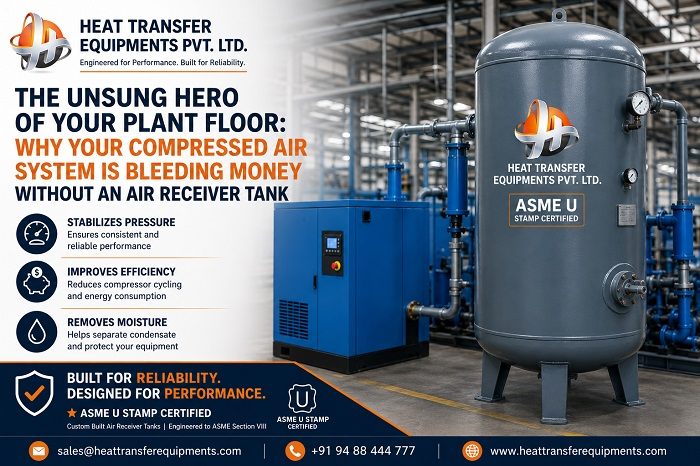
Depending on the application, vessels can be designed and manufactured according to applicable pressure-vessel codes and customer specifications, including ASME Section VIII .
Where applicable and specifically required for the project, ASME U Stamp certification can also be provided.
Important manufacturing and quality-control activities can include:
- Material inspection and traceability
- Controlled welding procedures
- Weld inspection and non-destructive testing (NDT)
- Dimensional inspection
- Nozzle and connection inspection
- Hydrostatic testing
- Surface preparation and protective coating
- Final quality inspection
These practices help ensure reliable long-term performance in demanding industrial environments.
Upgrade Your Plant’s Breathing Room Today
Stop allowing pressure fluctuations and inefficient compressor operation to affect your plant’s productivity.
A properly selected and engineered Air Receiver Tank can provide valuable compressed-air storage, improve pressure stability, help manage short-term demand peaks, and support more efficient compressor operation.
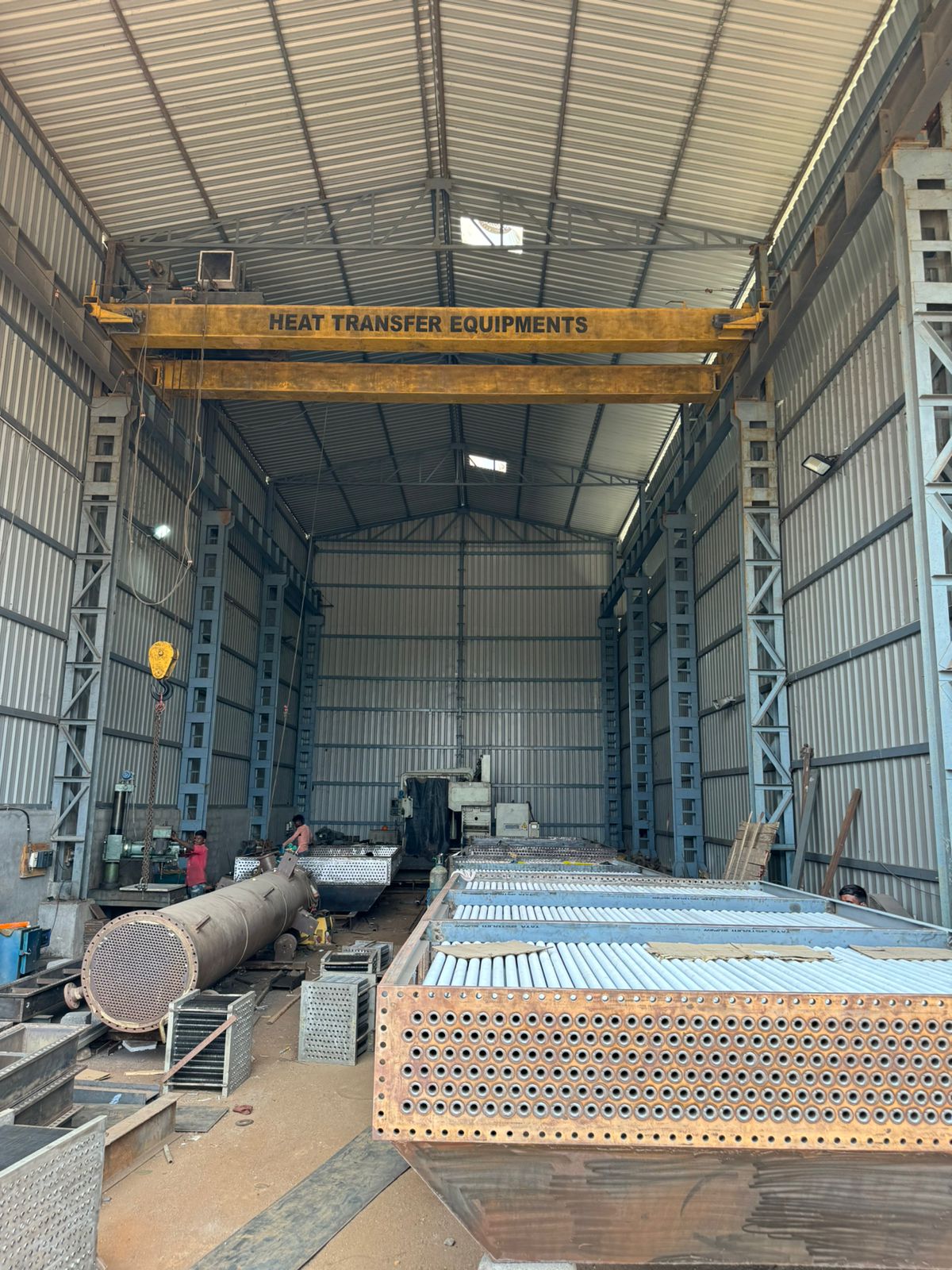
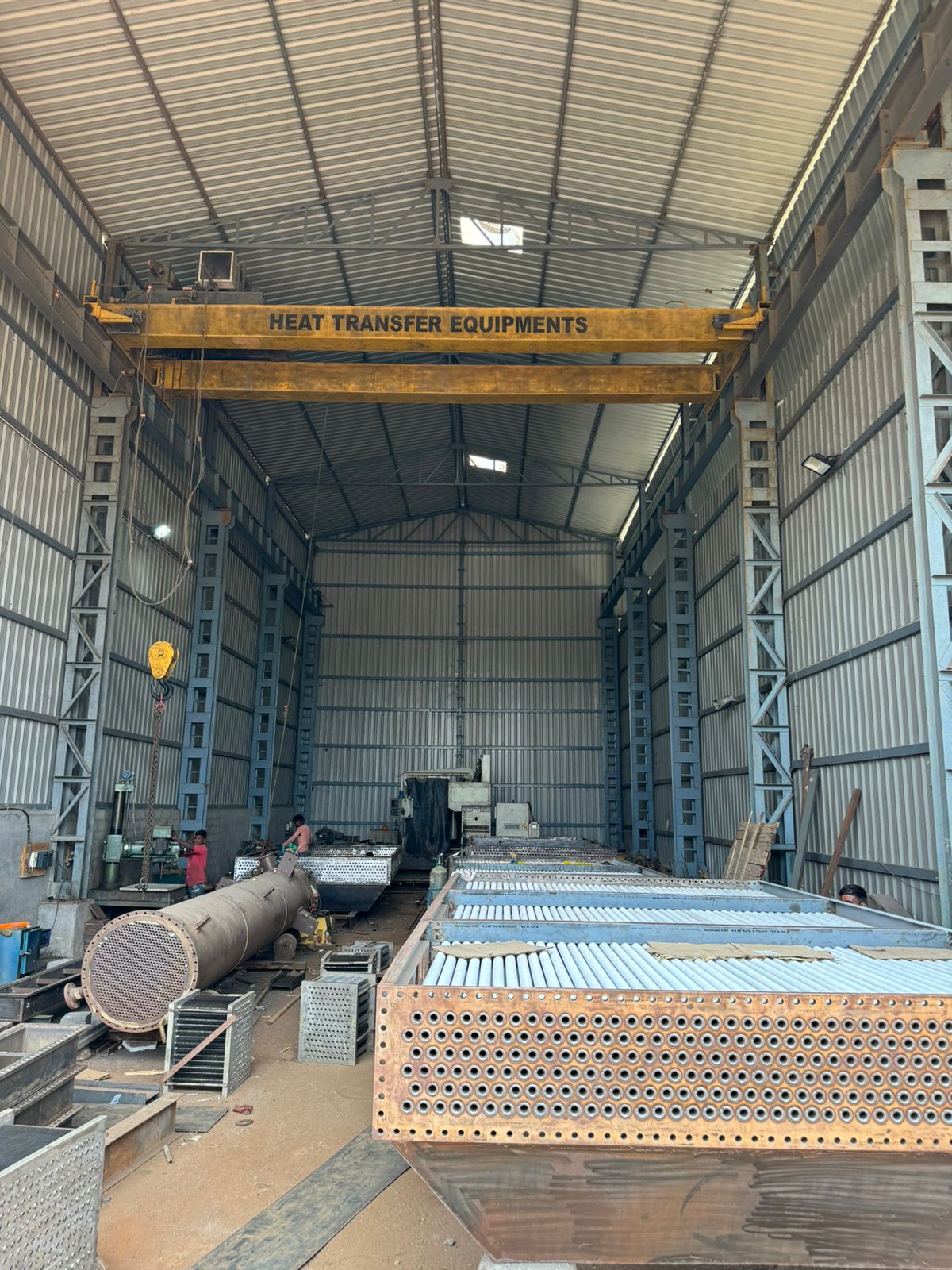
At Heat Transfer Equipments Pvt Ltd (HTEPL), Coimbatore, Tamil Nadu, we manufacture custom-built air receiver tanks based on customer requirements, including operating pressure, storage capacity, material selection, configuration, and applicable design standards.
Whether you require a vertical or horizontal air receiver for a new installation or an existing compressed-air system, our engineering team can help develop a suitable solution for your application.
Frequently Asked Questions
What is the main purpose of an Air Receiver Tank?
An Air Receiver Tank stores compressed air and acts as a buffer between the compressor and the plant distribution network. It helps manage short-term changes in air demand and stabilize system pressure.
Can an Air Receiver Tank reduce energy consumption?
A properly sized receiver can help reduce unnecessary compressor cycling and improve the way the compressor responds to changing demand. Actual energy savings depend on the complete compressed-air system and operating conditions.
Does an Air Receiver Tank remove moisture?
An air receiver allows some moisture and condensate to separate from compressed air as it cools. The collected condensate can be removed through a suitable drain system. Additional dryers and filters may still be required depending on air-quality requirements.
Which is better: vertical or horizontal Air Receiver Tank?
Neither configuration is universally better. The appropriate choice depends on required storage capacity, available floor space, overhead clearance, piping arrangement, support requirements, and maintenance access.
Looking for an Air Receiver Tank manufacturer in India? Contact our team to discuss your pressure, capacity, material, and configuration requirements.
- Email: sales@heattransferequipments.com
- Phone: +91 94 88 444 777