heattransferequipments.com > products > heat exchangers > cooling towers
HEAT EXCHANGERS & COOLING TOWER MANUFACTURER
Heat Transfer Equipment Pvt Ltd.,
HEAT EXCHANGERS
COOLING TOWERS
Adiabatic Cooling Tower
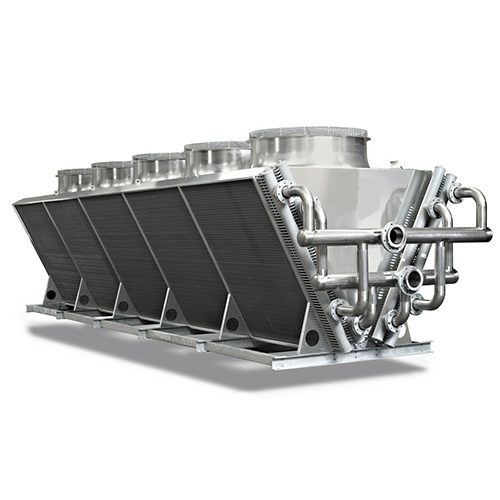
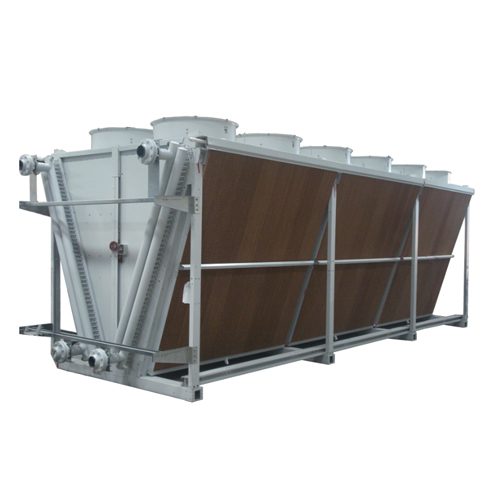
Heat Transfer Equipments manufactures adiabatic cooling towers for industrial processes that require effective heat rejection while reducing dependence on continuous water consumption. The system combines air cooling with controlled evaporative cooling to maintain the required process temperature when ambient conditions become challenging.
Adiabatic cooling towers can operate primarily with ambient air during cooler conditions. When the outside temperature increases and air cooling becomes less effective, a controlled water spray or wetting system assists the cooling process. This operating principle provides a flexible solution for industries requiring dependable temperature control.
What Is an Adiabatic Cooling Tower?
An adiabatic cooling tower is a heat-rejection system that uses air as the primary cooling medium and adds evaporative cooling when additional capacity is required. Unlike conventional evaporative cooling systems, water is used only when the ambient conditions require supplementary cooling.
The system is suitable for process cooling applications where maintaining stable fluid temperatures is important while controlling water usage.
How Adiabatic Cooling Towers Operate
During periods of moderate ambient temperature, the cooling system works mainly through dry air circulation. Heated process fluid passes through the heat-transfer section while fans move outside air across the cooling surface.
When ambient temperature rises, the adiabatic system activates its water distribution arrangement. Water is applied to the incoming air or heat-transfer surface, and evaporation removes additional heat from the air stream.
Once the required cooling condition is achieved, water usage can be reduced or stopped. This allows the system to adapt its operating mode according to ambient conditions and cooling demand.
Adiabatic Cooling Tower Design
The equipment is designed around the required heat-rejection capacity, process-fluid temperature, ambient conditions, airflow, and available installation space.
A typical system may incorporate a heat-transfer coil or cooling section, axial fans, motors, water distribution equipment, controls, structural supports, and associated piping.
The design can be selected according to process requirements, fluid characteristics, operating temperatures, and expected seasonal conditions.
Main Components of an Adiabatic Cooling Tower
An adiabatic cooling system generally consists of several coordinated components:
- Heat-transfer coil or cooling surface
- Axial fans
- Fan motors and drive arrangement
- Water distribution system
- Spray nozzles or wetting arrangement
- Water collection and drainage system
- Temperature and pressure instrumentation
- Control panel
- Structural frame and enclosure
Component selection depends on the required cooling duty, operating environment, water quality, and installation conditions.
Adiabatic Cooling Method
The cooling process combines sensible heat transfer through air circulation with evaporative cooling when additional heat rejection is required.
The process fluid releases heat through the heat-transfer surface. Air flowing across the surface carries this heat away from the system. During high ambient conditions, controlled water evaporation lowers the air temperature and improves the heat-transfer capability.
This combination allows the equipment to provide additional cooling capacity without operating continuously in a fully wet mode.
Industrial Applications
Adiabatic cooling towers can be used in industries where process equipment requires reliable heat rejection and controlled operating temperatures.
Industries commonly served include:
- Steel Industry
- Sugar Industry
- Paper Industry
- Chemical Processing
- Petrochemical Industry
- Power Generation
- General Manufacturing
- Process Industries
The final configuration is selected according to the process fluid, required cooling capacity, operating temperature, ambient conditions, and site requirements.
Where Adiabatic Cooling Towers Are Used
Adiabatic cooling systems can support a range of industrial cooling requirements, including:
Process Fluid Cooling
The system can remove excess heat from circulating process fluids and return them to the required operating temperature.
Equipment Cooling
Adiabatic cooling can be integrated into industrial systems where machinery, production equipment, or auxiliary systems require controlled cooling.
High Ambient Temperature Operation
The evaporative assistance provides additional cooling capability when elevated outdoor temperatures reduce the effectiveness of dry air cooling.
Water-Conscious Cooling Systems
Because water is introduced only when additional evaporative cooling is required, the system can help reduce water consumption compared with continuously wet cooling arrangements.
Key Benefits of Adiabatic Cooling
Adiabatic cooling towers provide several operational benefits:
- Reduced water consumption compared with continuous evaporative cooling
- Effective cooling during high ambient temperatures
- Ability to operate in dry mode under suitable conditions
- Flexible operation according to cooling demand
- Reduced potential for continuous water-related maintenance
- Effective heat rejection for industrial process systems
- Reduced mechanical noise compared with certain conventional cooling arrangements
- Compact installation options for selected applications
Actual performance depends on ambient conditions, process requirements, equipment sizing, and operating strategy.
Water Usage and Cooling Efficiency
Water consumption in an adiabatic cooling system depends on ambient temperature, humidity, process-fluid temperature, and required cooling capacity.
Under favourable ambient conditions, the system can operate without continuous evaporative assistance. When additional cooling is necessary, water is introduced for controlled evaporation.
Proper control of the water distribution system helps balance cooling performance with water consumption.
Factors to Consider Before Selection
Selecting an adiabatic cooling tower requires evaluation of the actual operating conditions and site environment.
Important parameters include:
- Required heat-rejection capacity
- Process-fluid flow rate
- Fluid inlet and outlet temperatures
- Maximum ambient temperature
- Relative humidity
- Available water quality
- Installation space
- Fan and motor requirements
- Operating pressure
- Material compatibility
- Maintenance accessibility
Providing these details during the enquiry stage helps engineers determine a suitable configuration.
Maintenance and Cleaning
Regular inspection and maintenance help maintain cooling performance and equipment reliability.
Maintenance activities may include:
- Inspecting heat-transfer surfaces
- Checking fan blades and motors
- Cleaning spray nozzles
- Inspecting water distribution components
- Checking electrical and control systems
- Monitoring fluid flow and operating temperatures
- Inspecting structural components
- Removing deposits from accessible cooling surfaces
The maintenance frequency depends on water quality, operating environment, dust loading, and equipment usage.
Frequently Asked Questions
Q1 : What is the main purpose of an adiabatic cooling tower?
An adiabatic cooling tower removes heat from a process fluid using air cooling with evaporative assistance when additional cooling is required.
Q2 : Does an adiabatic cooling tower use water continuously?
No. Water is generally used when ambient conditions require additional evaporative cooling. Under suitable conditions, the system can operate primarily with air.
Q3 : What industries use adiabatic cooling systems?
Adiabatic cooling systems can be used in steel, sugar, paper, chemical, petrochemical, power-generation, and other industrial process applications.
Q4 : What information is required for selecting an adiabatic cooling tower?
Important information includes cooling capacity, process-fluid flow rate, inlet and outlet temperatures, maximum ambient temperature, fluid properties, available water quality, and installation conditions.
Q5 : Can adiabatic cooling towers be customized?
Yes. The cooling arrangement, heat-transfer surface, fan capacity, water distribution system, materials, controls, and structural configuration can be selected according to the application requirements.
Q6 : What are the advantages of adiabatic cooling over conventional air cooling?
Adiabatic cooling can provide additional heat-rejection capacity during high ambient temperatures by using controlled evaporative cooling. This can help maintain the required process temperature when dry air cooling alone is less effective.
Q7 : How much water does an adiabatic cooling tower consume?
Water consumption varies according to cooling load, ambient temperature, humidity, and operating conditions. Since evaporative cooling is used only when required, water consumption can be lower than continuously wet cooling systems.
Q8 : How is an adiabatic cooling tower selected for an industrial application?
Selection depends on heat-rejection capacity, process-fluid flow rate, inlet and outlet temperatures, maximum ambient conditions, fluid properties, water availability, installation space, and required operating performance.
Request a Quote for an Adiabatic Cooling Tower
Looking for an Adiabatic Cooling Tower for an industrial process?
Share your cooling capacity, process-fluid details, inlet and outlet temperatures, flow rate, maximum ambient temperature, water availability, and installation requirements with our engineering team.
Heat Transfer Equipments can develop an adiabatic cooling solution based on the required thermal performance, operating conditions, and site requirements.
Contact us to discuss your cooling requirement and receive a customized technical proposal and quotation.